The introduction of quick-firing
artillery :
|
After having
equipped the artillery with quick-firing field guns, the Bulgarian Army felt
the need to purchase also modern field howitzers. At that time European Armies
did not agree about the calibre to adopt. In In January
1907, the negotiations about Bulgarian artillery
and ammunition were connected to a project of conversion of loans emitted in
Vienna and London in 1888 and 1889 at an interest rate lower than the 6 percent
they carried, whose execution would be entrusted to a
group of German (Disconto Gesellschaft, Deutsche Bank, Bleichröder)
and Austrian banks (Länderbank, Bank Verein), leaded by the French Banque de
Paris et de Pays Bas. The French did
not require a guarantee for the loan, and they offered terms more
advantageous than the loans of 1902 and 1904. This
conversion to 6% into 4.5% would make available a share of the budget of the
Debt, which would be used to guarantee a new loan of 68,000,000 francs. On The War
Minister major general Mihail Savov submitted the decision of the Committee
to the Council of Ministers that decided to pass the report to the Sobranie
for examination. Fearing that the order might not be given to Schneider, the
French warned the Bulgarian government that until the contract was concluded
there would be no loan on the Paris Bourse. The Sobranie understood that the
loan contract with French banks forced A first the sum of 17,200,000 francs should be share out in the
following way : -
6,000,000 francs for 100,000 shrapnel
for the 75mm QF field guns ; -
7,500,000 francs for 12 – 105mm howitzer
QF batteries; -
2,500,000 francs for 3 – 150 tons
torpedo boats; -
1,200,000 francs for various kinds of
equipments (mainly tents and medical supplies). The
remaining 7,800,000 francs would be reserved for 18 / 27 field gun batteries. The
whole order was assigned to Schneider
that would sub-contract at the firm Lefèbvre the 1,200,000 francs for the equipments. Since
Schneider had become the obliged intermediary of all the French firms in
their business in Nevertheless,
owing to the monopoly conceded by the banks to Schneider, on -
9 105mm field howitzer QF batteries :
each battery was equipped with four guns and 2000 shells (they were delivered
in 1910, but with a different calibre); -
9 75mm mountain QF batteries : each
battery was equipped with four guns, 3200 shrapnel and 800 H.E. shells (the
last delivery arrived in spring 1909); -
6000 shells for the 120mm Krupp
howitzers; -
-
117,100 shrapnel for the 75mm QF field
guns. The
total cost was 21,004,993 leva; guns and ammunition should be delivered
within two years. To complete the sum of 25,000,000 leva the Bulgarian
government ordered to Schneider engineer’s equipment (tools, cars, bridging
material, telephones, telegraphs, balloons) for 2,000,000 leva and to the
firm Lefebvre tents for 1,500,000 leva. Great part of this supplementary
order was delivered in 1911 and included Decauville railways with wagons,
trucks Brillié, optical signalling instruments system Mangin, projectors,
barbed wire and bicycles. In summer After having examined the reports of the tests
carried out in the presence of the Russian and Serbian commissions and of
col. Zagorski himself, on 23-24 January the Artillery Committee decided
definitively for the 120mm, and the execution of the contract signed in 1907
could finally start. The acceptance tests were carried out in December In 1911 the
War Ministry requested the funds to purchase some horse artillery batteries
to support the Cavalry Division, but only 16 machine guns were authorized and
assigned to the first four cavalry regiments. The outbreak of the Balkan War
kept from carrying out the original plan. During the war the lack of horse
artillery was regarded as a great fault for the Bulgarian cavalry. Therefore
1st battery of 5th not quick-firing artillery regiment was rearmed with
Turkish horse artillery guns and assigned to the Cavalry Division. With the
Edict N° 39/ In order to
simplify the question of ammunition supply, at the beginning of 20th
Century studies began to produce an Eihnheistgeschoss
(universal shell), a projectile combining both the effects of shrapnel and
H.E. shell. For this purpose Dutch 1st lt. Pieter Daniel van Essen
thought to add a high explosive head to the shrapnel and to fill the shrapnel
body with Trotyl placed between the bullets, where until then only a filling
producing smoke, called colophony, had been placed in order to make easier
the observation of the fire. The van Essen patent was bought by the German
firm Ehrhardt (Rheinmethall), that introduced the Brisanzschrapnell Ehrhardt-van Essen, a H.E. shrapnel, soon
followed by Krupp, that produced two different kinds of universal shell, the Granatsschrapnell (with separate head containing the high explosive)
and the Schrapnellgranate (with no
separate head, and the explosive shared into five different charges), and
finally by Schneider. They were equipped with special fuzes working on four
different ways : time for shrapnel, percussion for shrapnel, percussion for
H.E. shell, and percussion with delay for H.E. shell. In In 1912 the
Artillery Committee decided that from then on the field and mountain
artillery would be equipped only with universal shells, but later the
pressing requirements of the Balkan war forced to buy also common shrapnel.
In October-November 1912 the Bulgarian Army ordered 50,000 Brisanzschrapnell (half Ehrhardt and
half Krupp) for field and 10,000 for mountain artillery, along with 23,000
shrapnel for field artillery. |
|
|
|
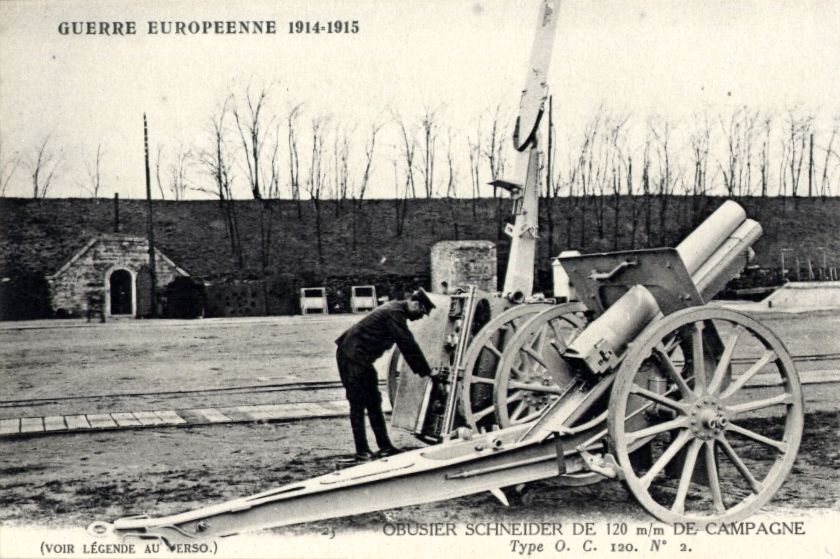
Bulgarian foreign loans 1888-1918 Schneider-Canet 75mm QF field gun
M. 1904 Krupp 75mm QF field gun M. 1903 Krupp 75mm QF mountain gun M. 1904 Schneider-Canet 75mm QF
mountain gun M. 1907 |