Drill regulations for quick-firing field
artillery
|
|
|
The
tactics of the field artillery was dealt in the manual Устав за
строевата служба
в полската
скорострелна
артилерия (Field
service regulations for quick-firing field artillery) published in 1906 and
finally adopted with modifications and
additions in 1908. It was an adaptation of the French Règlement de manovre de l’artillerie de
campagne published on 8 June 1903, but with the introduction of some
interesting alterations. The main difference was that in France the gunner
(tireur), who opened and closed the breech-block, also fired; in Bulgaria
this duty was assigned to the aimer. It
was divided into two parts: I.
Firing instructions and activity of the artillery in the field : gun, battery and division instructions, foot formations,
signs with trumpet and with flags, auxiliary activities (repairs, overcoming
local obstacles, swords exercises), writing reports, firing with the revolver,
tasks of the platoon commanders. II. Honours,
parades, inspections, manoeuvres. The
text deals only with training artillerymen in the use of the saber and
revolver. The carbine was introduced into the Bulgarian artillery only after
the Balkan wars and the related training appeared for the first time only in
the Field service regulation published in 1915 for Schneider and Krupp field
guns. Composition and subdivision of the units The
75mm Q.F. battery is organized as follows : – fighting
unit : 4 guns with 4 ammunition wagons subdivided into two platoons, 2 ammunition
wagons (1 with H.E. shells) as first supply echelon, 92 men and 83 horses; – battery
reserve : 6 ammunition wagons, field forge, a cart carrying entrenching
tools, reserve troops, reserve horses, hors rang troops, 92 men and 73 horses
– when the battery reserve has also a spare carriage it has also a carriage commander,
3 driver, 3 gunners and 7 horses; – transport
train : 1 field kitchen, 1 food supply cart, 6 forage carts, 1 officers’
baggage cart, 26 men and 22 horses. The
fighting unit carries 740 rounds, the battery reserve 588. Since 9 ammunition
wagons carry shrapnel, and 3 H.E. shells, every gun has 332 rounds at its
disposal. The guns and the ammunition wagons are drawn by six horses, the
forage carts by four, all remaining by two. Every
battery has one cart carrying 6 Linnemann spades, 6 picks, 2 axes and 8
little hatchets. In order to provide communication between the units every
battery has 4 field telephones with The
batteries are grouped by three in artillery division (or detachment – отделение, like the
German Army Abteilung). The division general staff is composed the head of
the division (later designed division commander), an officer as scout,
another officer as adjutant, a trumpeter and a N.C.O. as orderly. Every
artillery division is organized as follows : – fighting
unit : the division command and the fighting units of the three
batteries; – battery
reserve : the battery reserves and 1 spare carriage; – transport
train : the transport train of the three batteries and the transport
carts of the division. The gun A
quick firing artillery piece (оръдие,
pièce) consists of a gun (оръдие,
arrière-train de canon) and its ammunition wagon (ракла, arrière-train de caisson)
with its crew and horses and is commanded by a non commissioned officer, the
gun commander (командир
на оръдието,
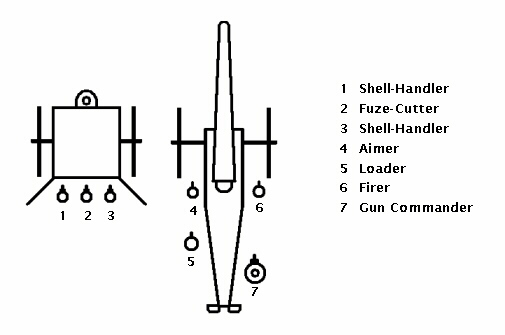
chief de pièce), and is attended by six gunners
(прислужници,
servants): |
|||
|
– the
aimer (мерач,
pointeur) gives the angle of sight and the deflection, points and aims the
gun, fires; – the
breech-blocker
(затворач,
tireur) opens and closes the breech-block; – the
loader (пълнач,
chargeur) puts the projectile into the chamber; – the
fuze-cutter
(поставач, déboucheur),
placed behind the caisson, sets the fuze and gives the projectiles to the
loader; – two
shell-handlers (подавач,
pourvoyeur), the right one and the left one, kneeling on the ground,
each behind one of the armoires of the caisson, place the shells in the
fuze-setter. |
|
||
|
The
gun commander commands, supervises
the correct and timely action of the gunners, the constant replenishment of
the gun with projectiles, the functioning of the materials, and the correct
movement of the remaining projectiles in the cells of the ammunition wagon,
when it begins to empty during shooting. |
|||
|
|
|||
|
In
battle formation
(боен строй) the gun is
unlimbered, with the spade sunk into the ground and the ammunition wagon
tilted on its left on the same line. Guns and ammunitions wagon can be
limbered and unlimbered only if they are in double column, when they were one
after the other, it is not allowed. Limbering and unlimbering are carried out
always at walk, but the limbers are usually conducted to the guns and
caissons at trot, unless a different gait is ordered. |
|||
|
|
In
route formation
(строй за движение)
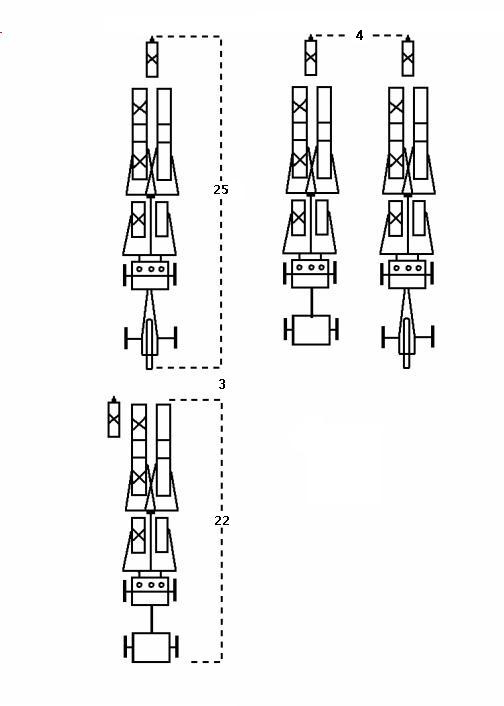
the gun and the ammunition wagon are limbered and moved in gun column
(оръдейна
колона), with the ammunition wagon behind
the gun, 3 paces away; or in double column
(вдвоено
оръдие), with the ammunition wagon alongside the gun, 4 paces away on
the left. When they are withdrawing, they swaps their places, the ammunition
wagon going before or on the right of the gun, keeping the same distances. A
gun team moving in column has a length of 47 paces and a front of 3 paces, in
double column a length of 25 paces and a front of 7 paces. The
gun squad is composed by 14 men : – the
gun commander and the ammunition wagon commander on riding horses; – six
drivers (three for each team) mounted on the left horses; – six
gunners (right to left) : a)
on the gun limber – aimer, loader, breech-blocker; b)
on the caisson limber – left shell-handler, fuze
setter, right shell-handler. When
the gunners are not on the limbers, they walk in a line behind the gun and
the ammunition wagon respectively. |
||
|
There
are three different gaits for field artillery : – at
walk: – at
trot: – at
gallop : In broken ground and during
prolonged marches the speed may be reduced. During uninterrupted marches the
rate of the march changes, alternating walk and trot. Marching alone the
field artillery usually moves |
|||
|
The battery The headquarters of the
battery are composed by the commander and the following men : – two
subaltern officers (possibly NCOs) as platoon
commanders, the senior one commanding the first platoon; – a
senior NCO as commander of the first
supply echelon; – a
NCOs detached from the park company as commander
of the battery reserve; – a
NCO as commander of the transport train; – a
feldwebel, assigned to the rear of
the battery during the marches, and responsible of the timely transport of
the ammunition from the park company and the replacement of the missing men
during the combat; – two
senior NCOs as observers, the first
attached to the battery, the second detached to an observation post, linked
to the battery commander by phone or signals; – three
junior NCOs as orderlies, in charge
for keeping the communications with the head of the artillery division, the
head of the Detachment, and so on; – three
NCOs as scouts, assigned to the
reconnaissance of the targets and of the roads; – three junior NCOs as signallers-telephonist,
in charge for linking the battery with the commander, when his is away from
the battery, the head of the artillery division, the observation post, and so
on; – two trumpeters, assigned to
the fighting unit and the battery reserve respectively. In route formation the battery can move : – in
column (колона), with the pieces at a
distance of 3 paces in column or in double column, according with the
conditions of the road and the war-demands; the battery reserve with the
ammunition wagons always in column, at a distance of 20 paces from the last
wagon of the fighting unit; the transport train, if not detached, at a
distance of 20 paces from the last cart of the reserve. A battery moving in column had
a length of 402 paces and a front of 3 paces, in double column a length of
292 paces and a front of 7 paces; – in
open formation (разгънат
строй) with the pieces in column or paired at
fixed interval; the
ammunition wagons of the 1st Echelon at 3 paces behind the first and the fourth
gun; the battery reserve with the ammunition wagons in
open formation, at a distance of 20 paces from the fighting unit; the hors
rang and reserve troops with reserve horses following at a distance of 10
paces from the last cart; the transport train, if not detached, at a distance
of 10 paces from the reserve. The
interval between the gun could be : great – 40 paces, middle – 20 paces,
small – 10 paces, arbitrary – the number of paces is ordered by the battery
commander. At trot, the hors rang and reserve troops are carried by the
ammunition wagons or formed an independent detachment and are left behind. The fighting unit of a battery
in open formation moving in column has a length of 70 paces, in double column
of 50 paces, the front was 120, 60 or 30 paces, depending on the interval
chosen. In
order to make the battery more agile, mobile and flexible, the battery
reserve can be detached and move also far from its fighting unit, up to 500 –
|
|||
|
In
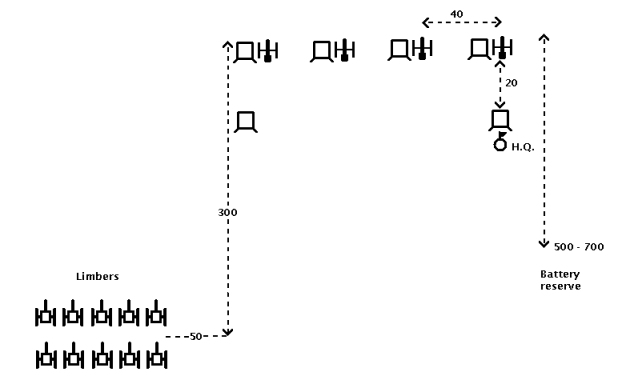
battle formation the guns unlimbered are
deployed side by side at great
intervals of 40 paces (as a rule, but exceptionally at 20 or even at 10 paces). The ammunition wagon tilted with
the armoured doors opened is put alongside the gun. The extension of the whole
firing line is around 120 paces. The ammunition wagons of the 1st
Echelon are positioned unlimbered at 20 paces behind the first and the fourth
gun of the firing line. The ammunition wagon carrying the observation ladder
can be placed near the observatory of the battery commander. |
|
||
|
The limbers of the fighting
unit are placed in shelters up to 300 paces away from the battery. With opportune
shelters, they can be placed even near the front, but if there was no
shelters, they were placed 300 paces behind and 50 paces on the side of the
battery, side by side on two line. The battery reserve is placed covered from
the enemy sight and fire, at a distance of 500- |
|||
|
The artillery
division The
headquarters of the artillery division
are composed by the head of the division (later designed division commander),
a scout officer, an adjutant NCO, a trumpeter junior NCO and an orderly NCO.
In addition every battery detaches an orderly from the fighting unit and
another from the battery reserve for the communications, and some NCOs and
scouts for the reconnaissance. In
route formation the artillery
division can move move : – in
open formation (разгънат
строй) with the batteries in open formation abreast in one line, the
intervals between them are 10 paces greater than the gun’s; the
battery reserves, if not detached, in open formation, at a distance of 30
paces from the fighting unit; this formation is used to advance and retire
from an open place under the enemy fire, in inspections and reviews; – in
column of batteries
(батарейна
колона), with batteries in open
formation, in succession at a distance of 30 paces; the reserve like the
fighting unit, 30 paces behind it; at great intervals it is used to approach
a place near the enemy, but out of its fire, at little intervals it is used
to deploy the artillery in mixed formation with other troops; – in
guns column (оръдейна
колона) or marching column
(походна
колона), with batteries in column of
guns, in succession at a distance of 30 paces; the reserve like the fighting
unit, 30 paces behind it; the transport train, if not detached, at a distance
of 30 paces from the reserve; this is the common marching formation, but it
can be also used to come into position
in broken ground under the enemy fire; – in
line of guns columns (линйя
оръдейни
колони), with batteries in column by
guns, in succession at a distance of 170, 90 or 50 paces, the number of paces
increasing or decreasing according to the place; the reserve like the
fighting unit, 30 paces behind it; it is the common manoeuvring formation: at
great intervals it is used to advance in enemy’s beaten zone depending on the site, allowing the
quick deploy of the troops and their retreat with little losses; at lesser
intervals this formation is used to manoeuvre
in broken ground under the enemy fire. The
battery reserves usually travel joined, under the command of an appointed
senior NCO, and are attached to the respective battery only exceptionally,
when the division commander orders it. When
the artillery division travels independently, the transport train is always
detached, except in column of route, and follows under the command of an
appointed senior NCO, moving according with the orders of the division
commander. In
battle formation the batteries are
deployed in fighting formation, along one line or by levels, with the
limbers, the battery reserves and the transport trains placed like in battery
battle formation. The deployment by levels allows a greater freedom of
action, hampers the enemy adjustment and diminishes the effect of its fire. Signals. At the beginning of the march,
every battery and every reserve sends an orderly to the division commander.
Similarly, the division commander sends an officer or a good NCO to the head
of the artillery of the Infantry Division. In action, every battery connects
with the division commander even by telephone. The artillery heads is
connected with the reserve, the park company, the covering infantry and the
infantry fighting troops. With infantry the communications are mainly visual. Command. On march,
the division commander conducts and directs the division through signals or
by means of adjutants, orderlies and trumpeters. In battle, he sets the
targets according with the instructions of the head of the artillery, gives
to the battery commanders all the data about their targets and fixes when
each of them must open fire. The battery commanders can change the target
only on his order, except when they have to repulse an unexpected enemy
attack or the communication with the command is cut off. The division
commander does not interfere with the adjustment fire, except when some
inaccuracies in the fire direction or errors are noticed during the
adjustment. Other artillery units The
artillery regiment is composed by
the headquarters, two or three artillery divisions, the hors rang platoon,
the medical staff, the artillery park company from the Division artillery
park, and the artillery supply platoon. The
artillery brigade is composed by
the headquarters, two artillery regiments with four to six artillery
divisions, and the artillery park company from the Corps artillery park. As
for their subdivision and their operations, the text referred to the Direction for the
employment of the field artillery in combat and the Field service regulations. |
|||