Direction for firing in field and
mountain QF artillery
|
|
|
The
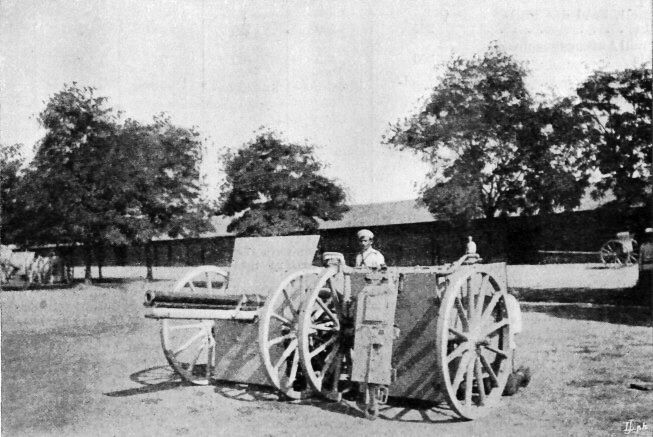
rearmament of the Bulgarian artillery with modern quick-firing guns, occurred
in 1904, required the introduction of new firing rules to replace those
published only two years before, in Between
1905 and 1908 the new guns were intensively tested and finally the revised
standard version of the Наставление за стрелбата
въ полската
и планинската
скорострелна
артилерия
was published in 1908, followed in 1909 by a detailed exposition written by
col. Kalin Naydenov (Новото наставление
на стрлбата
в полската
и планинската
артилерия на практика,
Sofia 1909), that covered only the first four section of the Direction. Basically the direction
deals with the quick-firing guns, but gives also some instructions about the
employment of the old not quick-firing guns on the new conditions. It
includes five sections : I.
Ballistic data concerning guns and projectiles. II.
Measure of the dispersion and calculation of the
corrections for shrapnel fire. III.
Preparation of fire : determination of the range, direction
of fire from covered positions, measure of the angle of site, observation of
the bursts. IV. Determination
of the primary data, fire for adjustment and fire for effect. V.
Fire practice :
demonstrative, training and fighting fire. Instructions for writing firing
reports. The
direction includes also the firing tables of all kinds of field and mountain
guns adopted by the Bulgarian artillery. Generalities. The artillery
takes part in the combat only with its fire. Quick-firing artillery shoot to break
down any resistance with a rapid and powerful fire of short duration from
opportune and well chosen positions at the most
important targets in a particular moment. With the
enormous increase in fire effect due to the introduction of magazine rifles and
quick-firing artillery, troops, and especially infantry, do not expose
themselves except for a very short time to the artillery fire, utilizing to
the utmost all available cover. To succeed, the fire for effect must begin as
far as the objectives appeared, and consequently the process of adjustment must be shortened as much as possible. The Direction does not prescribed precise
ranging against a definite target, but to cover a considerable extent with
shrapnel bullets, to block every attempt to every object to move about or
remain there uncovered, without being put out of
action. Field
howitzers. The field howitzers shoot
relatively heavy projectiles with low initial velocities, so that their
trajectories are more curve. With the same weight of projectile, they use
several charges smaller than each other, which give trajectories for the same
distance, more curved than each other, and therefore with greater angles of
incidence. This makes possible, by selecting the distance and the
corresponding charge, to obtain an angle of incidence from 40° to 48° and an
angle of dispersion of up to 60°. The field howitzers are specially assigned to
destroy the dugouts of the field fortifications and to fire on live targets
behind artificial shelters and in the steep folds of the ground, because this
kind of targets requires more curved trajectories and more
powerful projectiles. They can be used
together with field guns for shelling animate targets in the open, for firing
against shield artillery and for destroying any kind of inanimate targets. At exposed live targets and at vertical
inanimate targets, howitzers fire at full charge, in the first case even at
long range. To hit live targets howitzers use shrapnel, while to destroy
inanimate targets torpedo shells. Projectiles. The Direction
examines all kinds of projectiles employed both by quick-firing and not
quick-firing guns, describing in detail their main features and their
effects. It considers also the
projectiles fired by 120mm not quick-firing howitzers assigned to the heavy
field artillery, and by the 105mm quick-firing light field howitzer, that at
that time the Bulgarian Army intended to buy in France. At that time the
120mm not quick-firing howitzer was equipped only with shrapnel and common
shells, but later it received also Schneider built torpedo shells. Time shrapnel is regarded as the main projectile of field and mountain
artillery against all animate targets that are not under cover. It contains about 300 lead bullets (200 for
mountain guns), that, spreading out from the point of burst in the air, form
a sheaf and cover a space of considerable width and depth. Consequently,
shrapnel fire does not demand a complete adjustment, being sufficient to
approximate to the target. In addition, shrapnel contains a smoke-producing
composition called colophan to make the burst more
visible and facilitate the adjustment. This characteristic can
be used also for tactical purposes. The rapid fire of a quick-firing
battery with smoke-producing shrapnel makes a dense cloud of smoke in front
of the enemy line, preventing him from taking an effective aim or protecting
the attacking troops. Shrapnel is equipped with a double action fuze, which permitts not only
to change at will the point of burst (time fire), but also to burst on graze
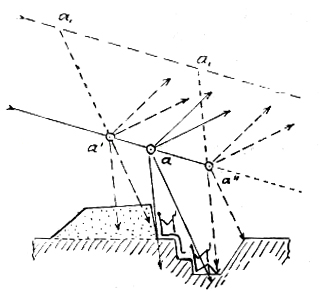
(percussion fire). When the shrapnel bursts, the body falls 10- At a range of 2500 m
and with an interval of burst of 50 m, the average density of hit is : – 75mm
QF and 87mm not QF field guns 1.5; – 105mm
QF field howitzer 1; – mountain
guns 0.5. Percussion shrapnel usually bursts after having hitting the
ground or having ricocheting. In this way, it changes a little its direction
and greatly reduces its final velocity and therefore the living force of the
bullets. Against animate targets it is less
effective than time shrapnel, but it can destroy small inanimate targets like
bridges, thin walls, fences, light shelter. It can be used
against shielded artillery, when high explosive shells are lacking. |
|
|
Percussion high explosive shell is used either against shielded batteries at a range of |
|
|
Even at close range and with hard ground it
requires a very careful adjustment, since its effect is very
local. It can be successfully employed to harass the occupant of the
hostile trenches, waiting the moment when the troops are forced to man their parapets. Having a very sensitive fuze the H.E. shell bursts as soon as hit the ground,
without ricocheting, making two cones of dispersion :
the lower one hits the target, while the upper one scatters upward and is
almost inoffensive. The angle of the cone of dispersion is between 110°-140°.
The explosion gives a very great number of splinters (even 500-700), which,
reaching a very high speed (up to 600 m/s), can inflict disabling wounds, if
the target is at 30-40 paces. Their action in deep, however, is small and at
a distance of more than 50 paces from the bursting point, they are almost
useless. Torpedo shell is the most powerful projectile of the field
artillery. It is employed by the field howitzers to
destroy every kind of inanimate targets. It is equipped with a delay-action fuze, when it must penetrate the roof of splinters proof
before exploding, but it is equipped with a simple percussion fuze when it must explode on impact. It is able to mess
up earthworks, destroy armoured shelters and sound buildings and sweep away
every kind of obstacle that might meet with on the battlefield. The most powerful effect is
produced when it falls at an angle greater than 30° on a stiff ground.
In this case, it makes a crater Field howitzer shrapnel has almost the same action of gun shrapnel,
the main differences are : – the interval of burst must be lower, since its
trajectory is steeper; – the density of hits is greater and the beaten
area wider, since it contains more bullets; – the power of penetration of the bullets is
greater, since they are heavier. Firing at uncovered animate targets, the
howitzers employ the full charge to obtain a sloping trajectory,
on the contrary, firing at troops under cover, they employ the low charge to
obtain a steep trajectory. Common shell is
used only by not quick-firing guns against animate and inanimate targets. Against shielded guns it is preferred to the shrapnel. Against animate
targets at mid range, it is effective when it
bursts no more than 20 m in front of the target and no more than 3-4 m behind
it. At close range and against high targets, the extent of the area of burst
can be little greater, increasing up to 30 m. Against wide animate targets it
is employed only out of the sphere of action of the shrapnel. At
mid ranges it can pierce an earthwork 2 m thick, a brickwork
0.75 m thick, and a wooden palisade 0.35 m thick. It can destroy every kind
of stone wall that may be meet in the battlefield. Case shot is used
only by not quick-firing guns to beat off close attacks at a range of 400 m
at most.
The cone of dispersion of the balls has an angle of opening of 6° with
an axis of dispersion of 1/10 of the length and a range of only 400 – 500 m.
With quick-firing
guns, it is replaced by shrapnel, which bursts
approximately 100 m in front of the gun when the fuze
is set at zero, and approximately 150 m in front of the gun when it is set at
0.3 seconds. Shrapnel
fire. Shrapnel
adopted by Bulgaria, like all the shrapnel employed
at the beginning of 19th Century, has base charge with a sheaf of
moderate angle of spread. At |
|
|
|
|
|
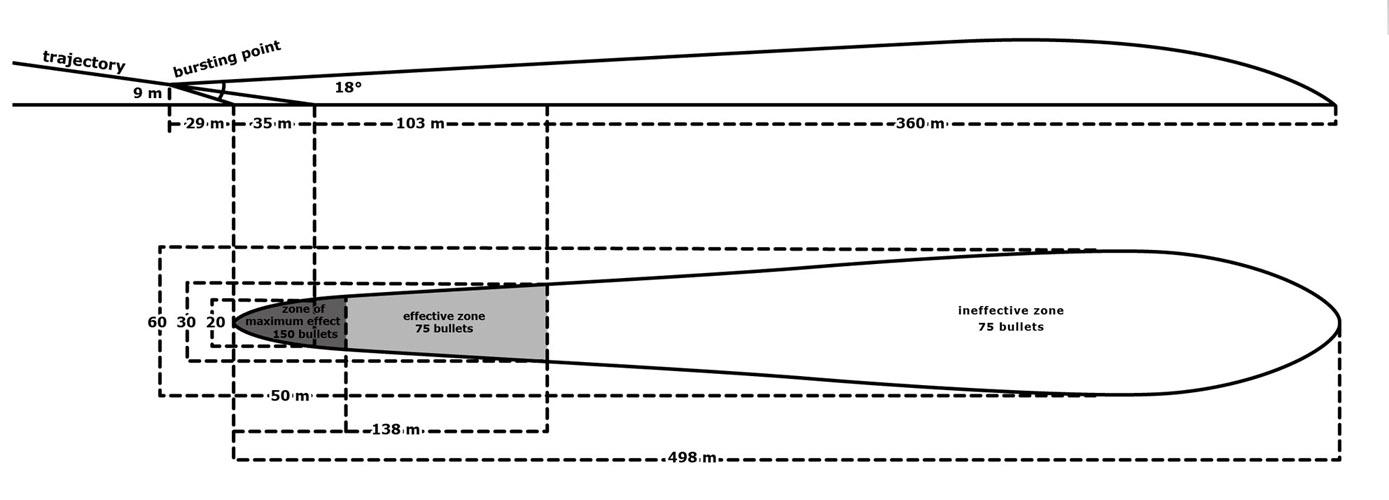
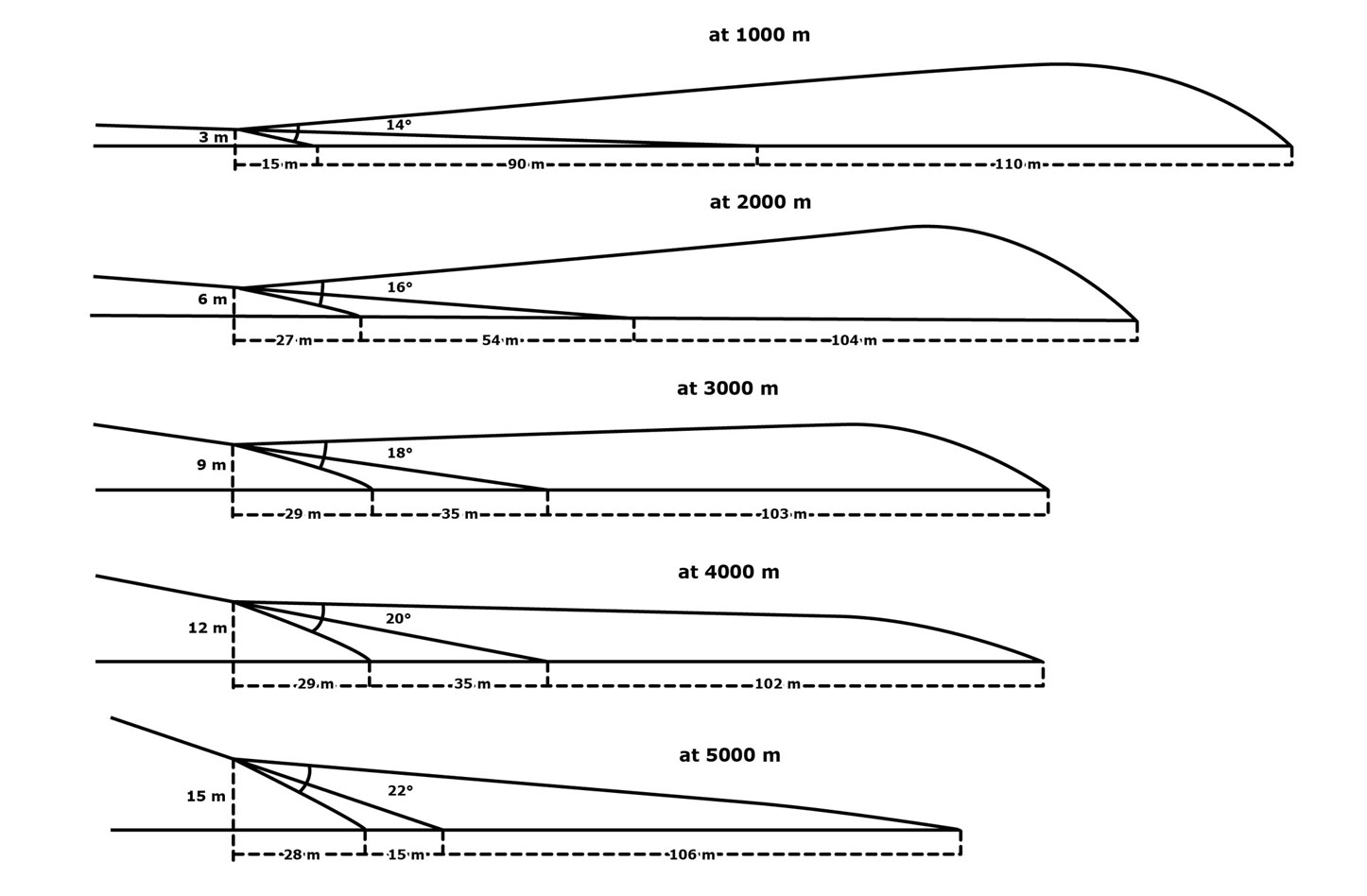
The effect of shrapnel fire is
somehow affected by the range, the interval of burst, the height of
burst, the size of the targets, the ground and the shelters. Increasing the range, the shrapnel fire becomes less effective, since the
velocity of the bullets decreases and, with it, their striking power; the
trajectory becomes steeper and the bullets cannot ricochet on the terrain;
the combustion of the fuze becomes less regular;
the extent of the effective area decreases. The greater
effect is obtained up to |
|
|
|
|
|
Shrapnel
bursting too far in front of the target and those bursting in the air above
the target produce little of no effect. Therefore the interval of burst of the shrapnel,
i.e. the horizontal distance between the point of burst and the target, must
be carefully set, since shrapnel are really effective only if they burst
close to the target : the greater is the interval of burst, the greater is
the dispersion of bullets, the less the density, and consequently the smaller
the number of hits. The normal interval of burst is det at 30- The
height of burst, i.e. the vertical distance of the point of burst
above the horizon, must be carefully adjusted,
taking into account that the combustion of the fuze
is not always uniform. A probable deviation of The
effect of shrapnel fire increases with the size of the targets
: the greatest is their
surface, the more vulnerable they are. The density of hits requires to hit a
target can be easily obtained, knowing the area of the surface exposed,
which, according with the estimate of that time, are as follows : 1)
horse and rider, side view – horse and rider, front view – 2)
skirmisher, standing, front view –
0.4 sq. m; skirmisher, standing, side view – 0.3 sq. m; skirmisher, kneeling, side view – 0.3 m; skirmisher, lying down – 0.20 m; skirmisher, covered – 0.05 m. To hit a animate
target, the imaginary vertical surface in which it is located must to be
covered with such a density that one bullet falls on each part of the
quadrant meter represented by the target. Thus, to hit a standing infantryman
it is required a density of 2.5, to hit a kneeling skirmisher behind a
parapet a density of 20. To make a unit unable to continue fighting, it
is enough to put out of order in a short time 50% of its men. For this, it is
sufficient if the fire continues until a specific density is obtained for the
various targets : –
cavalry : 0.5 –
infantry, standing : 1.0 –
infantry, lying down :
1.5 –
infantry, uncovered : 2.5 –
infantry, behind a
parapet : 10.0 Since shrapnel bursts in air, the effect of
time fire depends less upon the character
of the terrain than any other kind of projectile. Nevertheless
it has some influence. Indeed, if the terrain in front of the target is level
and hard, the bullets will ricochet easily and loose little of their
velocity, being able to produce still effective hits. But
if it is broken or soft, the majority of the bullets will imbed themselves in
the ground. The same happens when the slope of ground is rising at the
target. In addition, the width of the cone of dispersion is greatest when the
slope of the ground is equal to the angle of fall of the unexploded shrapnel.
As the slope of the ground increases, the width of the zone of dispersion
decreases. When the slope of the ground is greater that the angle of fall of
the lowest bullet, no effect is produced at all. Shrapnel fire is ineffective against troops under cover, i.e. located immediately
in rear of parapets or any kind of obstacle, since behind them there is a
blank space, where the bullets cannot penetrate or are powerless and
ineffective. The depth of the blank space can be calculated
multiplying the height of the cover by 8, 6, 4, 3
for ranges of 1, 2, 3, 4 km respectively. The closer the range, the most
sloping the trajectory, the broadest the blank space : with a cover Shrapnel fuze correction. Shrapnel usually employs the double-action delay fuze. With quick-firing field guns, the fuze is adjusted mechanically with a special fuze-setter,
while with not quick-firing guns it is set manually. For quick-firing field guns, the fuze is calibrated with a height of |
|
|
Preparation of fire.
The primary firing data, that must be determined, were :
1) range, 2) deflection, 3) angle of sight – for indirect laying, 4)
corrector – for time fire, 5) width,
depth and kind of the target. The
range to the target can be measured
on a map, or obtained by telemeter, battery
telescope or field glasses, or estimated by eye or by sound. While previously
the distance was estimated mainly by eye, this Direction focuses its attention to the
use of the rangefinder. When it was published the Bulgarian Army employed mainly the Souchier prismatic telemeter, adopted also by the Russian
Army, but the Goerz
rangefinder The range according with the
effectiveness of the fire are : – for
field guns: up to 1500 m close, from 1500 m to 3500 m mid, more than 3500 m
great; – for
mountain guns: up to 1500 m close, from 1500 m to 3000 m mid, more than 3000
m great. The
correction in deflection is
necessary to overcome the effects of wind and drift. With moderate winds the deflection must be changed, adding or subtracting 1 millième, depending upon the direction of the wind, 2 millièmes with strong winds. With field guns every When the guns are placed
in masked or covered positions, before firing, the battery commander must
determine the angle of sight. It can be measured by the battery telescope, by means of the
sight and quadrant, by means of the
graduated ruler (reglette de direction, calculated
on the map or through theoretical formulas. The corrector
is used to fix the height of burst of time-fuzed shrapnel, as shown above. Since nearly all kinds of objects may be the target of the artillery fire –
infantry, cavalry and artillery in many different formations, field
fortifications, bridges, buildings, woods, balloon etc. – to be really
effective the fire must be distributed and adapted to the main features of
each of them. The
firing tables contain all the data for producing fire and calculating the
corrections of the shots in all the cases and for all distances over 100 m. Observation
of the bursts. The
direction emphasizes that one of the main conditions for fast and accurate
adjustment and fire is the correct observation of the bursts relative to the
target. Since this can be obtained only with
continuous and methodical training, all officers, warrant officers, and
non-commissioned officers must be trained annually in observation, along with
training in measuring and determining distances. The observations are done with the help of binoculars and if they are
difficult for one reason or another, an auxiliary observer must be sent. Firing
projectiles with percussion fuze, the bursts must be observed at the first
appearance of the smoke, especially when the projectile falls close to the
target or there is wind, taking into account that : – if
the cloud of smoke and dust cover the target, the burst is in front of the
target; – if
the target is covered by some of the smoke and dust, the burst is beyond the
target; – if
the smoke appears on one side of the target and soon passes to the other, the
burst is close to the target; – firing
from high positions, or at targets placed on the steep side of the heights,
the bursts from this side appear below the target, and the bursts from the
other side above it; – shells
falling on the target can be best recognized by the hit or movement produced
in the target; – firing
at an interrupted target (battery, infantry company deployed by platoons…)
the bursts, which occurs in the intervals cannot be always determined with
certainty, so only well-observed falls must be retained; – if
the area around the target has gullies that hide the smoke from the bursts,
the distance must be measured with maximum precision and the area plotted on
the map; – shrapnel with
T&P fuze bursts on impact as soon as it hits
the ground; impact bursts differ from low time bursts by the shape of the
smoke and by the fact that the smoke is often mixed with ground. Firing
shrapnel with time fuze,
the bursts must be observed in four respects : – how
high above the target the burst occurs; – where
the bullets fall, – weather
the burst is in front of or behind the target and how much, if it is possible
to determine it; – the direction of the burst
relative to the target. The
burst heights are measured on the millièmes scale
of the binoculars or of the battery telescope, with the graduated ruler (only
at close range) or by eye. When the fuze is set at a distance greater than that of the
target, the shrapnel falls in the ground. Therefore, the observer should be
very careful not to mix it with the time burst: this
case it was known by the finger that rises around the target before the burst
and by the development of the smoke, which, in contrast to ordinary burst,
occurs from the bottom up. Perspective
sketch. Finally the Direction
explains how to prepare perspective sketch, that can be used to : – to
easily orient the high commander, when they arrived at the position or at the
observation post; – to
direct and control the fire of an artillery division of a group of batteries,
when its head is distant; – to
offer to the battery commander information about the firing data related to
different points of the battlefield; – to permit to the observers to
show to the firing guns about the position of their targets. To direct the fire according to the sketch, or
to transmit what was seen from the observation post, it is necessary : a)
to show the number of the
point around which a target appeared; b)
to show how far to the
right or to the left of that point the target right flank is; c)
to show how far the
target is from here or there from the indicated point; d)
to
give the width of the front of the target. Determining the lateral distances (b), the
approximate angular difference in the position of the batteries and the
observation post should be taken into account. According with these instructions, the battery
commander lays the guns to the indicated point, and order to open fire, that is controlled by signals with flags. |
|